
Introduction: Laser wattage describes how much optical output a fixture produces, while the visual result on site depends on distance, ambient light, and how tightly each beam holds together.
Buyers comparing animation laser lights usually meet the same short list of numbers: 5W, 10W, 15W, 20W, 30W. It is tempting to read those numbers as a simple quality score where the biggest one wins. In practice, the ladder works more like a capacity scale. A higher step gives a fixture more light to work with, and that extra light matters most in large, bright, or long-throw situations. this guide explains what each step represents, why two fixtures with the same rating can look different in the same room, and how the tiers line up with general venue sizes.
What the 5W to 30W Power Ladder Represents in Animation Laser Lights
The five numbers describe one product family sold at different output levels. A 5W, 10W, 15W, 20W, or 30W rating refers to the combined optical output of the laser sources inside the housing, not the electricity drawn from the wall and not the brightness of the final graphic on a surface. Each step up the ladder adds optical headroom: more light leaves the aperture, so beams can hold their shape further from the projector and stand out against stronger stage lighting. A 5W unit has enough output for close, controlled work; a 30W unit carries reserves that let a beam stay assertive in a busy room. Where does that extra power physically go? Laser diodes turn drive current into light, so a higher rating generally means more diode emitters, more drive current, and more heat inside the case. RP Photonics notes that diode output and thermal behaviour are closely linked, which is why higher tiers are built differently rather than simply relabelled. For a venue operator, that shows up as how comfortably a fixture handles a long show night after night, not just as a bigger number on a spec table. The rating tells you the light budget you can work with before distance and room conditions start eating into it.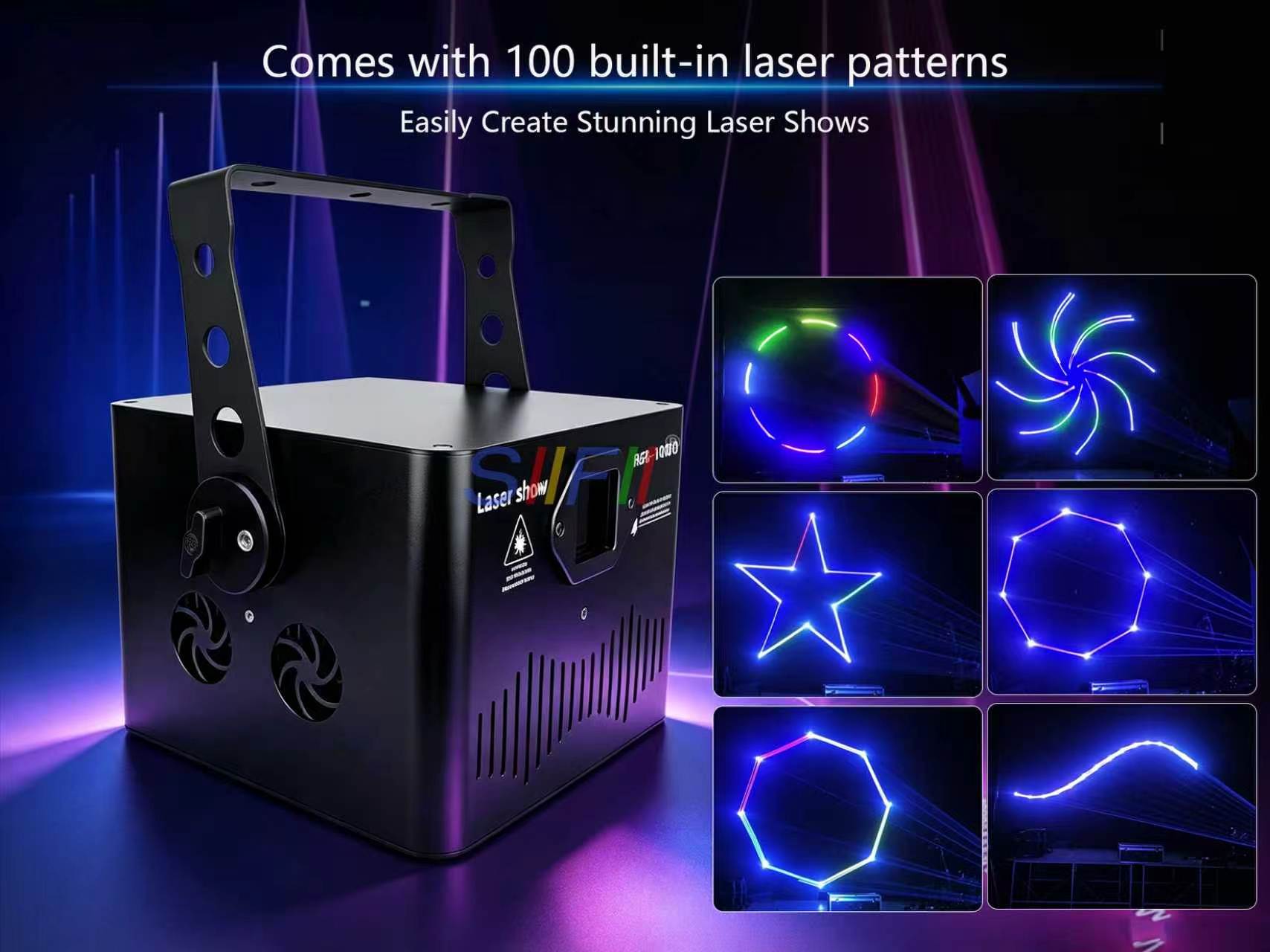
Why Power Alone Does Not Define Visual Impact Across Venue Sizes
Power is the easiest number to compare and the least complete. Two 10W fixtures can look noticeably different in the same club, because visual impact is really about contrast: how much light from the beam reaches the audience's eye compared with everything else competing for attention. Lighting on stage, LED walls, daylight through windows, and haze in the air all shift that balance. Beam divergence and scanner speed are not confirmed in the documented specifications for this model, so the optics below are general principles rather than a measured profile of one unit.
1. Beam Divergence Spreads the Same Output Over a Wider Spot
Beam divergence is the angle at which a beam widens as it travels. A tight beam keeps its energy concentrated in a narrow column, so it looks sharp and punchy far from the projector, though the spot stays small. A wider beam spreads the same output across a growing area, which makes the beam look fatter and softer, and dimmer per square metre at a distance. RP Photonics describes divergence as an angular property, and the practical consequence is simple: a lower-power fixture with tight divergence can read more clearly across a hall than a higher-power fixture that spreads quickly. This is why wattage alone cannot predict which beam will look stronger in a given room.
2. Venue Distance and Ambient Light Set the Real Contrast Level
In a small, dark room, a 5W beam cutting through light haze is easy to see, and the graphics land crisply on a nearby wall. Move the same fixture into a large hall with bright stage washes and the beam thins out, competing with everything around it. Distance makes this worse in two ways: the beam widens, and the light reaching the audience from any single point drops. Ambient light sets the floor the beam must beat. Fog or haze in the air gives the beam a surface to reflect from and makes the whole path visible; without it, viewers mostly see the graphic where it lands on a wall or floor. Those conditions decide how much output is genuinely useful.
Matching Power Tiers to General Venue Scale Categories Without Distance Promises
As a rough mapping, 5W suits small rooms, close projection surfaces, and low ambient light, such as a compact bar, a rehearsal space, or a private event corner. The 10W step is the middle of the ladder and the version most often used as a reference point in this series; it gives a small-to-mid room more presence and keeps beams readable where a little stage lighting is already running. The 15W and 20W tiers move into mid-sized clubs, live rooms, and small theatres where the projector sits further from the audience and the lighting rig is busier. The 30W top step is aimed at large halls, big club rooms, and event spaces with strong ambient light, where a beam has to carry across a long sightline. These are general associations rather than fixed rules, because a 15W fixture with tight divergence can out-punch a 20W unit that spreads widely, and a dark room flatters any tier. It also helps to separate output from features. Across this lineup, the control stack stays the same: DMX animation laser light control with switchable 18 or 27 channels, master-slave and sound-active modes, app control, and support for a custom PC controlled stage laser setup. Choosing a tier is therefore about how much optical headroom a room demands, not about unlocking extra functions. Sanfei Stage Lighting lists the 5W, 10W, 15W, 20W, and 30W variants as one family, with the 10W animation laser light as the middle reference.
Conclusion
The 5W to 30W ladder is best understood as a capacity scale for optical output, not a ranking of quality. Each step gives a fixture more light to spend against distance, ambient light, and beam spread. Small, dark rooms rarely need the top of the ladder, while large, bright halls benefit from the reserve that 20W and 30W tiers provide. Matching the tier to the room, rather than buying the biggest number, is the practical takeaway. Readers can review the listed specifications and the product reference to see how the variants sit within one control platform.
FAQ
Q: What do 5W, 10W, 15W, 20W, and 30W mean in animation laser lights?
A: They are output tiers within one product family. Each figure describes the combined optical output of the laser sources inside the fixture, so a 30W unit has more light to work with than a 5W unit. That extra output helps beams stay visible at greater distances and against brighter surroundings. The rating does not describe wall power draw or the brightness of a graphic on a wall, and it says nothing about divergence, which is measured separately.
Q: Does a higher wattage laser light always look better in a larger venue?
A: Not automatically. A larger room rewards output, but only if the beam stays concentrated enough to read at that distance. A wide-spreading 30W beam can look softer than a tighter 15W beam, and heavy haze or a dark room can make a modest fixture look striking. Wattage is a useful starting filter for big spaces, while divergence, mounting position, and ambient light decide the final impression.
Q: Why can beam divergence affect laser visibility more than power alone?
A: Divergence controls how quickly the beam widens. A tight beam keeps its energy in a narrow column, so it stays intense over distance. A wider beam spreads the same output across a larger area, which lowers intensity per square metre and makes the beam look dimmer and softer. This is why a lower-wattage fixture with tight divergence can sometimes out-read a higher-wattage fixture that spreads quickly.
Sources / References
Laser Diodes – semiconductor, gain, index guiding, high power
Related Examples
Sanfei Stage Lighting 10W Animation Laser Light product reference


