
Introduction: Dust on the front lens and heat trapped inside a sealed housing both change how a warning beam looks over months of outdoor service.
A highway laser warning light is installed once and then judged from a distance, usually at night, usually by whether drivers seem to react. That makes long-term appearance easy to misread. A beam that looks softer than it did in the first month is not necessarily a failing unit, and it is not automatically a design problem either. Two ordinary things happen to outdoor optical equipment: the front lens collects what the air carries, and the housing collects heat that the electronics inside keep producing. Understanding those two paths explains why a beam changes, why a weatherproof casing is not the same as a maintenance-free product, and what to look at before assuming anything is broken.
Why Dust on the Lens Changes Beam Visibility
The optical path in a highway laser warning light is short and unforgiving. Light leaves the diode, passes through a small collimating lens group, and exits through the front window as a shaped beam. Every one of those surfaces is a boundary the light must cross, and the outer lens face is the only one exposed to open air. Dust that settles there does two things at once. It blocks a fraction of the light before the beam ever leaves the fixture, and it scatters the rest at angles the optics never intended. From a distance, both effects read as a weaker beam core and a soft glow spreading around it. A routine field scenario makes this concrete: a warning unit mounted on a gantry over a long, monotonous straight section. In its first weeks the projected spot has a crisp edge and a clear shape against the road surface. After a dry, windy season, the same unit is viewed from several hundred metres away and the spot looks thinner, its edge blurred, and the beam appears less defined against the dark. Nothing has failed; the laser is still emitting and the rotating mount is still sweeping. What changed is how much light survived the trip through a dusty lens and how much of it left the beam axis on the way out. That gradual drift is why dust deserves attention. A diode that dies announces itself; a lens that slowly collects a film of grit does not. The change happens in small increments across many nights, and anyone who sees the beam every evening adapts to it without noticing. Drivers arriving at the site for the first time see the current result, not the original one. The useful habit is to treat beam appearance itself as the signal. A spot that looks fuzzy, a visible haze around the aperture at close range, or a beam that no longer reads clearly from the distance it used to cover are all observations about the optical path rather than about the electronics. Dust on the lens is the first thing to consider before assuming a power or driver fault.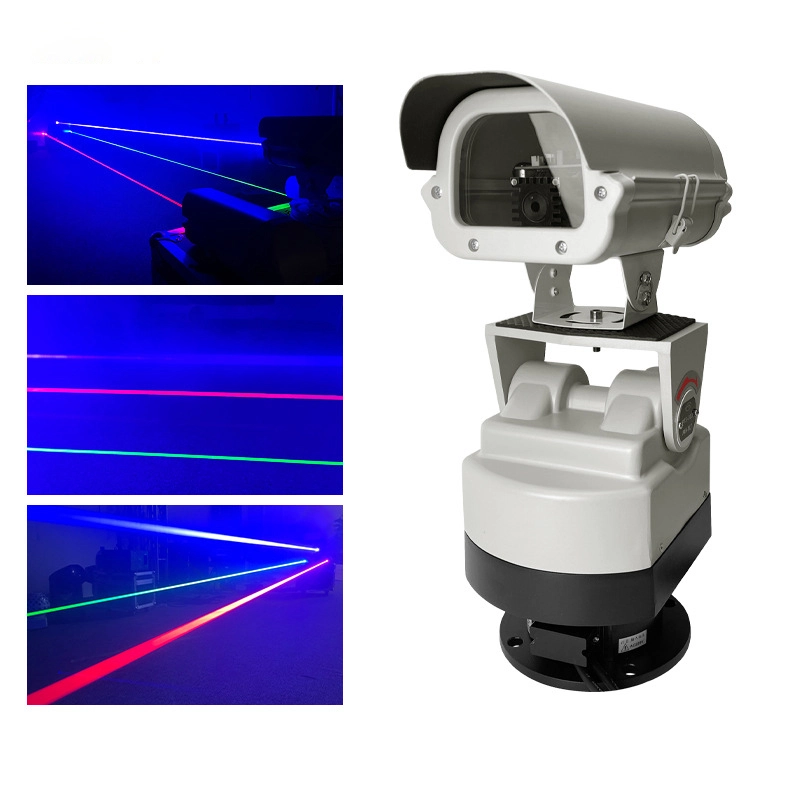
How Heat Builds Up Inside a Sealed Outdoor Laser Housing
1. Laser Diodes and Driver Electronics Both Add Heat to the Same Small Space
A laser diode converts electrical current into light with less than perfect efficiency, and the difference leaves as heat at the junction. That heat matters for two reasons: it shifts the emitted wavelength and affects the beam the diode produces, which is why high-power diode assemblies are built around thermal management rather than around the diode alone. The driver electronics and the rotation mechanism add their own losses into the same enclosure. In a fixture rated at around 100W total input, a meaningful share of that energy never becomes light. All of it has to go somewhere, and inside a closed housing the only route out is through the casing walls and whatever surface area the design exposes to moving air.
2. Sealed Housings Trade Air Exchange for Weather Protection
An outdoor housing that keeps rain and grit away from the optics also keeps air from moving freely through it, and those two goals pull against each other. The practical result is a housing that runs warmer than the ambient air around it, especially on a sunlit afternoon when the casing absorbs solar load on top of internal heat. This is normal behaviour, not a defect. Published figures for this class of highway laser warning light include an operating range of -35°C to 40°C and a laser output stability of ±5%. Those numbers describe how the unit is expected to behave across its working range. They also explain why heat is worth thinking about as a long-term condition rather than a one-off event: a fixture that spends every summer afternoon above 35°C is living near the top of its published range, and the same fixture in winter sits near the bottom.
What a Weatherproof Casing Can and Cannot Prevent
A weatherproof casing does real work. It keeps rain, spray, road grit, and insects away from the diode, the driver board, and the internal optics, which is where contamination would do the most expensive damage. The robust structural design and modular build described for this type of highway laser warning light also matter over years of service, because a module that can be reached and replaced keeps a damaged unit repairable instead of disposable. That is the protective side of the story, and it is a genuine advantage in roadside equipment that may sit on a gantry for a decade. What the casing cannot do is equally practical. It cannot stop dust from settling on the outside of the front lens, because that surface faces the open air by design. It cannot remove the heat generated inside, because the same walls that block water also resist airflow. And weatherproof wording describes protection against weather, not a promise that the unit needs no attention. The public description lists weatherproof casings, a -35°C to 40°C operating range, and ±5% output stability; the specific IP rating and cleaning interval are not specified, so a fixed service schedule should be confirmed rather than assumed. The sensible reading is simple: the casing protects the interior, the exterior lens face still belongs to the environment, and the beam you see from the road is the combined result of both.
Conclusion
Dust and heat are the two ordinary conditions that sit between a warning light's published specifications and the beam a driver actually sees. Dust on the front lens scatters light before it leaves the fixture, quietly softening a spot that once looked sharp. Heat generated by the diode, the driver, and the rotation mechanism has to escape through a casing that was sealed to keep water out, which is why a weatherproof housing runs warm and why the published -35°C to 40°C range and ±5% output stability describe working conditions rather than guarantees. Neither issue announces itself. Both show up as a slow change in how the beam looks from a distance, which makes beam appearance the most useful thing to watch. Anyone comparing fixtures or caring for an installed one can read the published product information for Sanfei Stage Lighting's highway laser warning light and treat the beam itself as the ongoing report.
FAQ
Q: Why does dust on an outdoor laser warning light lens make the beam look weaker?
A: Dust particles block part of the light and scatter another part away from the beam axis before the light ever leaves the fixture. The beam core loses intensity and the edges blur, so from a distance the spot looks thinner and softer even though the laser is still working normally. The effect builds slowly over weeks, which is why it is easy to overlook until the beam is compared with how it looked when new.
Q: Does a weatherproof housing also keep an outdoor laser warning light cool?
A: A weatherproof housing protects the optics and electronics from water, grit, and insects, and that same sealing limits airflow through the enclosure. Heat from the laser diode, the driver, and the rotation mechanism leaves mainly through the casing walls, so the housing typically runs warmer than the surrounding air, particularly in direct sun.
Q: Can heat change the output stability of a high-powered laser warning system?
A: Yes. Laser diodes are sensitive to temperature, and warmth shifts both the emitted wavelength and the beam the diode produces. That is why high-power diode assemblies are built around thermal management and why output stability is quoted as a figure such as ±5% across a published operating range of -35°C to 40°C. A unit sitting near the top of that range for long summer periods is working under the conditions the figure describes.
Sources / References
Laser Diodes – semiconductor, gain, index guiding, high power


