
Introduction: Outdoor shows bring dust, mist, and rain into play, and IP65 protection applies only to the waterproof variant of a 10W animation laser light.
A production team booking an outdoor weekend festival usually makes the same decision twice: once when they draw the lighting plot, and again when the forecast changes. The second decision is the harder one. An animation laser light that performs perfectly inside a club can meet wind-blown dust, stage mist, condensation, and sideways rain the moment it hangs on an outdoor truss. The useful question is not whether the laser is bright or well built. It is whether the specific unit on that truss was built for the exposure, because a standard indoor model and an IP65 waterproof model are two different configurations of the same fixture.
Why Outdoor Stage Productions Need a Separate Waterproof Laser Variant
A laser housing has more openings than it first appears to have. There is the output window where the beams leave, the seams between panels, the cable entries, the power inlet, the control panel or display window, and often a key switch or mode selector. Indoors, dust collects on the outside and the fixture quietly tolerates it. Outdoors, those same openings become paths: wind pushes fine dust into every gap, haze and stage mist settle on warm surfaces, and rain arrives sideways rather than straight down. Water rarely enters a fixture in one dramatic splash. It creeps along a cable, sits in a connector, and works its way through a gasket that is slightly compressed. That is why the protection rating belongs to the variant, not to the power class. The 10W animation laser light is offered in a No Waterproof version and an IP65 Waterproof version. The standard model is an indoor fixture built for clubs, theatres, and covered stages. The IP65 variant is the one intended for outdoor water-jet exposure, and it is the only version to consider when a truss position can actually get rained on. Brightness, graphics, and control style — DMX animation laser light programming, app control, or a custom PC controlled stage laser workflow — say nothing about how a housing handles water. The fixture also carries CE and RoHS declarations, which cover regulatory conformity for the electrical product rather than the enclosure's dust and water behaviour.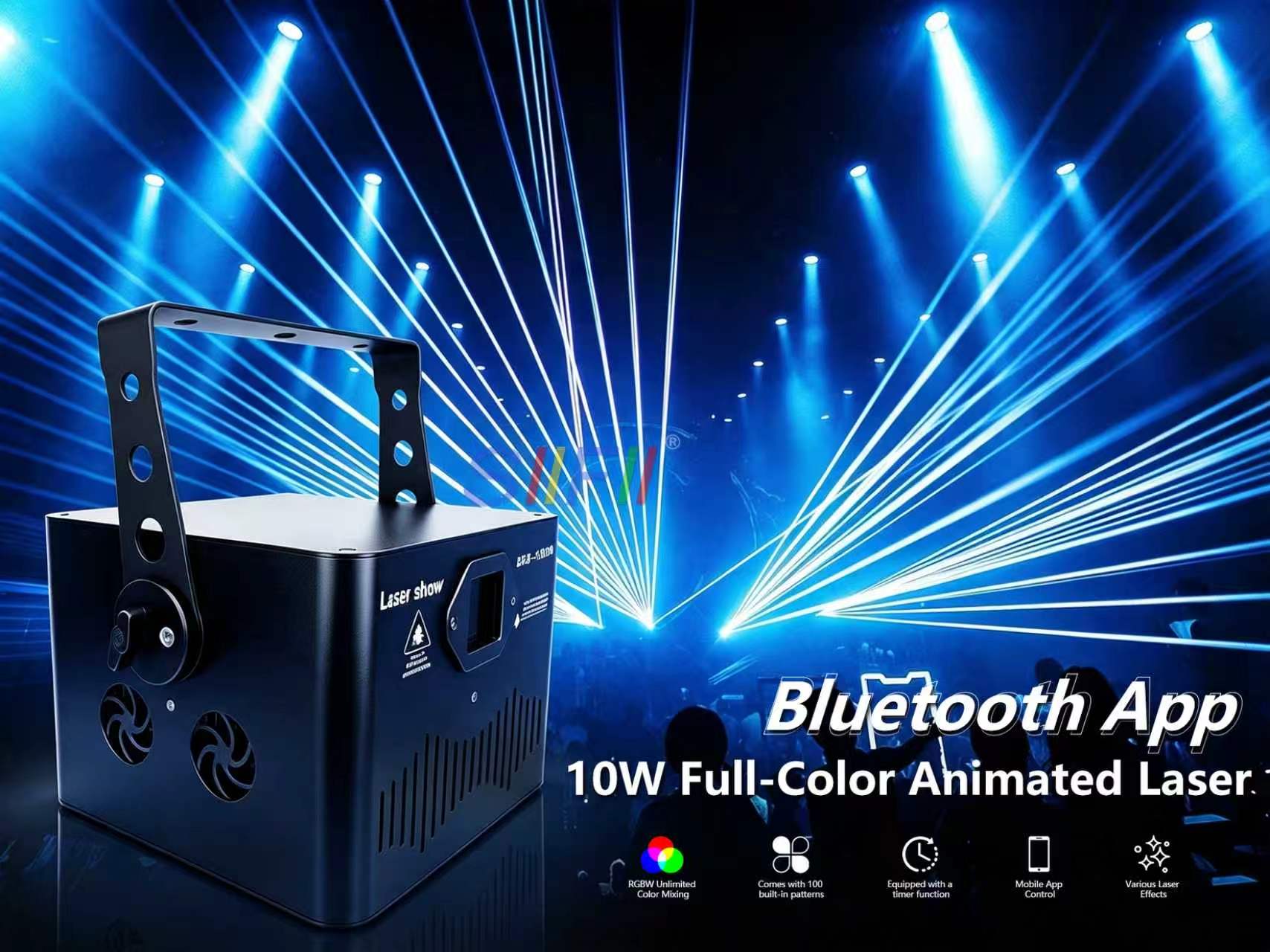
Reading IP65 Through the Two IEC 60529 Digits
IEC 60529 defines the IP code as two separate digits, and each one answers a different question. The first digit describes protection against solid objects, including dust. The second describes protection against water. Reading them apart is what makes an IP number useful, because a single "weatherproof" label hides which of the two risks a fixture was actually built to resist. For an outdoor stage laser, both risks matter at once: a dusty, wind-blown field site is hard on seals long before it rains, and a rainy night is hard on them in a different way. IP65 splits into a 6 for dust and a 5 for water.
1. The First IP65 Digit Covers Dust Sealing Across the Whole Enclosure
The 6 means the enclosure is dust-tight: no dust enters during the test, and a person cannot reach hazardous parts inside. On stage equipment that translates into a design task rather than a single feature. Every opening has to be closed by something — a bonded output window, a compressed gasket along each panel seam, a gland where the cable enters, a cap on each unused connector, a sealed membrane over the display and buttons. One loose connector cap or one unsealed cable entry undoes the digit, because dust only needs a single path. Outdoor dust is also abrasive and mixes with mist into a paste that clings to warm housings, so the seal has to hold across a whole season of shows rather than a single night.
2. The Second IP65 Digit Covers Water Jets Rather Than Immersion
The 5 describes protection against water jets: a stream from a 6.3 mm nozzle at limited pressure and volume, aimed at the housing from any direction, must not cause harm. In practical outdoor terms that covers wind-driven rain striking the housing, splash thrown up from a wet stage floor, spray drifting across a festival site, and the occasional wash-down during cleaning. It is deliberately not the same as 6 (stronger jets), 7 (temporary immersion), or 8 (continuous immersion). A fixture rated IP65 is built to shed water that hits it, not to sit in water. That distinction decides which mounting positions are acceptable and which are not.
Setting Realistic Outdoor Use Limits for an IP65 Waterproof Stage Laser
Used within its definition, the IP65 variant fits a wide range of outdoor show work: truss positions over a stage or audience barrier, festival side stages, cultural-night events, plaza installations, and any site where the fixture sees dust, haze, mist, and rain arriving at an angle. Placement matters as much as the rating. Hang the fixture so water runs off instead of pooling on a flat top surface, form a drip loop in the cable before it reaches the connector, keep unused ports capped, and keep the housing clear of standing water on a stage deck or a loading dock. Connectors and cable entries are where most water reaches electronics, and they are also the parts a crew touches most during load-in and load-out. The other half of realistic use is accepting what IP65 leaves to the installer. Multi-hour heavy rain, water pooling on a horizontal surface, a fixture stored in a wet road case, pressure washing, and condensation after a cold night turns into a warm morning all sit outside the water-jet definition. IP65 is also not a maintenance-free label: gaskets take a set, seals get nicked during transport, and connector caps go missing, so a quick inspection before each outdoor booking is what keeps the rating meaningful in practice. Laser safety planning runs alongside all of this. Outdoor displays need a documented risk assessment, controlled beam paths, and a competent operator, and those requirements stay the same in the rain.
Conclusion
Outdoor suitability comes from three things lining up: the right variant, a mounting position that lets water drain away, and a crew that keeps seals and connectors in order. IP65 already tells you which of those the hardware covers — a dust-tight enclosure that survives directed water jets — and which it leaves to the people rigging the show. For anyone comparing fixtures, the more useful move is to read the variant label rather than the power figure. The 10W animation laser light from Sanfei Stage Lighting is sold as both an indoor No Waterproof model and an IP65 Waterproof model, and only the second one is meant to meet rain.
FAQ
Q: What does IP65 mean for a waterproof stage laser light?
A: It means the enclosure passed two separate checks from IEC 60529. The 6 says it is dust-tight, so no dust gets inside and nothing live can be touched through openings. The 5 says it withstands water jets aimed from any direction at limited pressure and volume. Together they cover wind-driven rain, splash from a wet stage, and spray drifting across a site.
Q: Is every 10W animation laser light safe for outdoor use?
A: No, and the rating is the reason. The 10W animation laser light is offered in two builds: a No Waterproof version designed for indoor use and an IP65 Waterproof version intended for outdoor water-jet exposure. Only the IP65 variant is meant to meet rain. Outdoor use also depends on beam-path planning, controlled audience areas, and a documented risk assessment for the venue.
Q: Can an IP65 laser light be left in heavy rain or standing water?
A: No. IP65 covers directed water jets, which is a smaller claim than immersion. Prolonged heavy rain, water pooling on a horizontal surface, storage in a wet case, pressure washing, and condensation swings all fall outside that definition. The rating is also not maintenance-free — gaskets, seals, and connector caps need a look before each outdoor booking.
Sources / References
IEC 60529:1989+AMD1:1999+AMD2:2013 CSV
The Safety of laser lighting displays - HSE
CE marking - Internal Market, Industry, Entrepreneurship and SMEs
Related Examples
Sanfei Stage Lighting 10W Animation Laser Light product reference


