 Application Scenarios
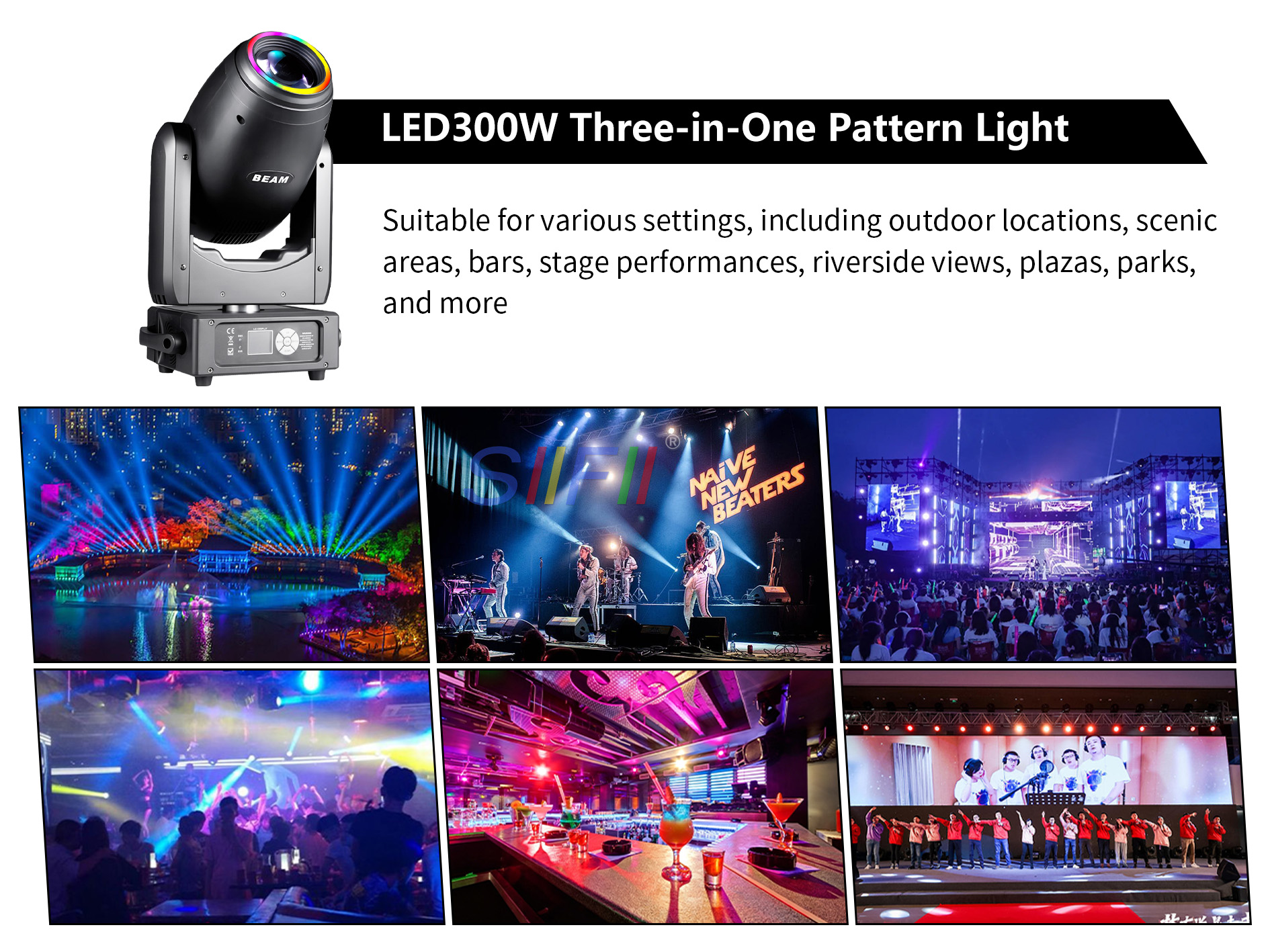
1. Commercial Entertainment Venues Perfect for bars, nightclubs, KTV rooms and disco parties. The diverse beam, pattern and soft fog effects create dynamic and layered nightclub atmospheres, greatly improving venue entertainment sense.
2. Performance & Ceremony Events Widely applied in wedding ceremonies, theatrical performances, live concerts and stage galas. Precise pattern projection and flexible zoom lighting perfectly match different event themes and stage layouts.
3. Exhibition & Commercial Activities Suitable for exhibition shows, brand launch events, corporate annual parties and indoor cultural performances. High-bright programmable lighting quickly highlights stage focus and enriches on-site visual effects.
Factory Service & Customization Support
As a professional stage lighting manufacturer, we strictly implement full inspection and aging tests for every 300W 3-in-1 moving head light before shipment. We support global sample order testing and flexible OEM customization including parameter adjustment, function setting and logo printing. All products are compatible with international voltage standards and equipped with complete after-sales technical support, ideal for long-term wholesale, stage rental and engineering project cooperation.
Inquiry & Cooperation
If you need reliable 300W 3-in-1 pattern moving head lights for stage projects, bulk wholesale or rental business, feel free to contact us. We provide real test videos, detailed spec sheets, factory competitive prices and one-stop stage lighting solutions.
Product Overview
The 300W 3-in-1 pattern LED moving head light is one indoor fixture doing three jobs that a small stage usually splits across three lights: a hard-edged beam, a projected pattern and a soft wash. A 300 W white LED module sits behind a motorised zoom running from 4° to 35°, so the same head can cut a narrow column down a long hall and then open out to cover a dance floor or a ceremony aisle. That range is what makes it useful on a tight truss. Where a venue might once have hung a pair of beams, a separate gobo spot and a wash light, two or three of these carry the whole look, each taking one clamp, one power cable and a block of DMX channels. If you’ve compared a 295W moving head light for sale with this class of fixture, you’ll usually find the real difference in the zoom and the effects package rather than in the headline wattage. If you are looking at stage lighting equipment for sale for a fixed venue that runs several different kinds of night, this is the sort of fixture that covers the schedule without a second purchase. If you need reliable 300W 3-in-1 pattern moving head lights for stage projects, events or rental use, feel free to contact us. We provide real test videos, detailed spec sheets, competitive prices and one-stop stage lighting solutions.
Gobo, Colour & Prism Effects
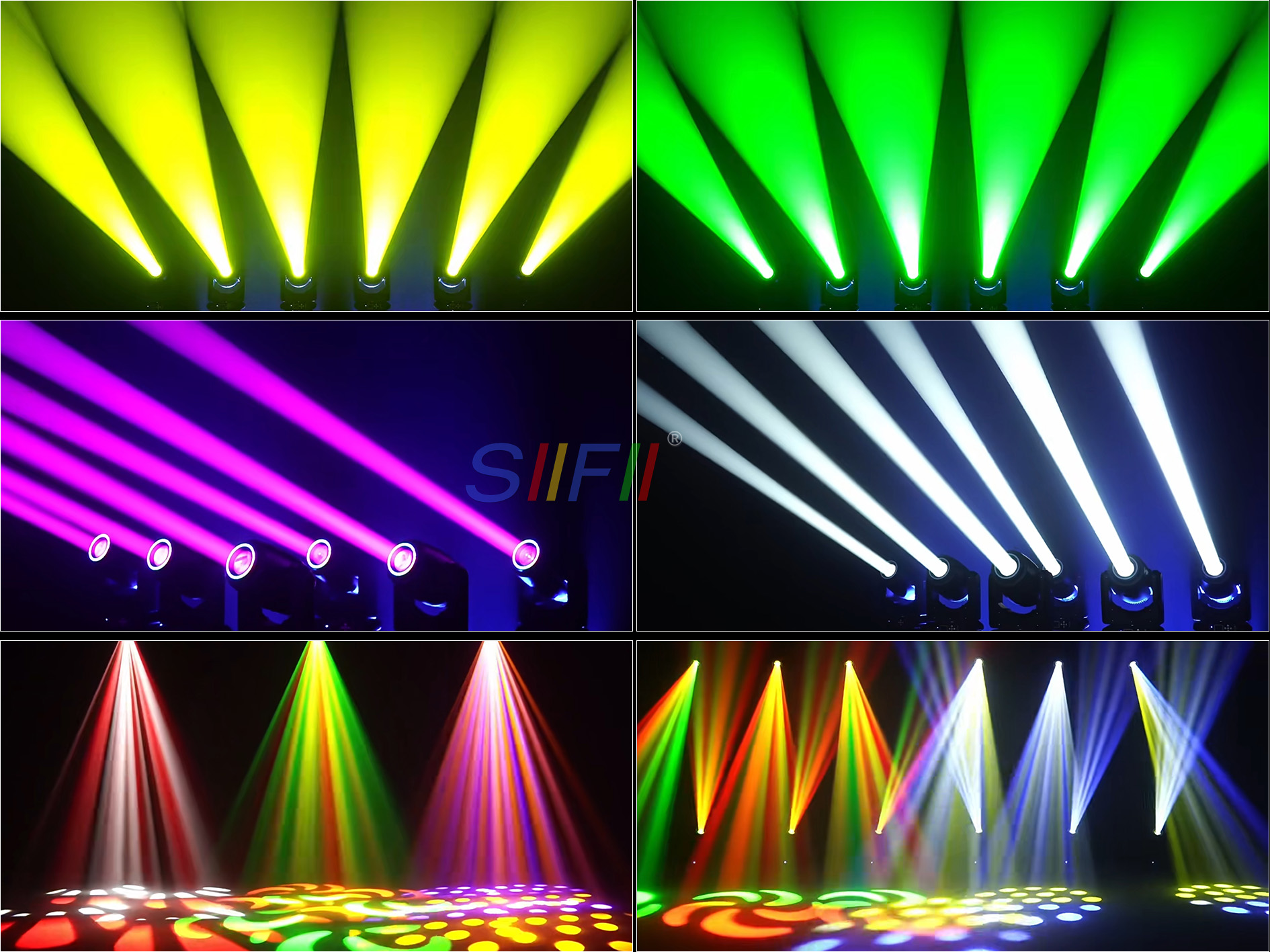
On a 3-in-1 moving head light, the colour and gobo package is what earns the fixture its place on the truss. A nine-colour wheel plus open white covers the usual stage palette, and the half-colour function holds two adjacent slots in the light path at once, so a single beam can split into two tones without a second fixture sharing the position.
Eight fixed gobos handle the standard texture and break-up looks — a count worth checking when a 295W moving head light for sale is compared against this one. Seven glass patterns rotate, each one forward or backward on its own, so a pattern can crawl, spin or hold still while the prism splits the beam into a fan — the single eight-facet prism rotates independently of the wheels, which is the effect most rooms ask for on a chorus or a drop.
Two more effects sit on the discs: a water-flow effect that pushes moving texture across a wall or a floor, and an independent fog effect that softens the beam edge into a wash, which is the third effect behind the 3-in-1 name. Dimming runs linearly from 0 to 100%, so a fade-out does not step. The beam aperture measures 19.8 mm and the pattern aperture 11 mm, which is worth noting if you match lens accessories to the head.
Cooling, Care & Safe Operation
Four heat pipes and four fans move heat out of the head, and electronic temperature control cuts the power automatically if the internal temperature climbs past its limit. That is why a unit shutting itself down mid-show is usually a blocked intake rather than a failed LED — check the fans before booking a repair.
Keep the front lens and the fan intakes clean. Haze and smoke fluid leave a film on optics that dims output and softens patterns, and dust on the fans is what starts the overheating in the first place. A soft dry cloth on the lens and a soft brush or low-pressure air over the intakes, done on a maintenance day rather than during a show, keeps the fixture close to how it left the production line.
Store and transport it dry. The housing is high-temperature resistant plastic, which copes with the heat of a long show but not with a wet load-in, so a flight case or a covered shelf between events is what keeps dust out of the optics and the mechanisms free. And because IP20 means no protection against splashes, check what sits above and below the mounting point before hanging an indoor moving head light over a bar rail.
Rigging, Addressing & First Setup
- Check the room first. This is an indoor moving head light rated IP20 with a working range of -20 °C to 40 °C, so confirm the position is under cover and that the fan intakes at the head and base have clear air around them.
- Plan the weight and the clamp. Each 3-in-1 moving head light measures 31 × 20.5 × 55 cm and weighs 13.15 kg net, 15.3 kg gross in its box; allow for the bracket and a safety cable on every point before you book the truss.
- Mount the head. The yoke bracket takes a standard clamp for truss work, and the flat base lets this beam moving head light stand on a plinth or a stage deck where the ceiling is too low to fly anything.
- Set the address at ground level. Addressing and function settings are quicker on the moving head beam light before it goes up, and quicker still from the desk if you are running RDM.
- Patch and check the travel. Give each moving head stage light its channel block, then run the zoom from 4° to 35°, both gobo wheels, the prism and a colour change before doors open — faults found here cost minutes rather than a show.
- Power it sensibly. Units run on AC 110V-240V, 50/60 Hz with a 400 W rated draw, so spread them across circuits instead of loading one ring to its limit.
- - Beam, gobo and wash from one head — this moving head beam light cuts a hard column, projects a pattern or softens into a wash, so a venue with one truss position gets three distinct looks from a single clamp and a single power feed.
- A zoom you can cue — swapping a tight 4° column for a wide 35° spread is a fader move, not a lens change or a second fixture, which keeps changeovers inside the running order instead of between it.
- Movement that holds its position — 16-bit electronic error correction on both axes keeps cue positions from creeping during a long show, so the look you set at rehearsals is the look the audience sees at the end of the night.
- Control headroom on a small desk — the channel layout separates zoom, colour, gobo rotation and prism, so a four-unit rig still leaves room to build looks instead of tying every parameter to one fader.
- Panel control before the desk is patched — addresses and basic functions can be set from the rear panel and display, which is how most units get configured on site before the console is even powered up.
Commercial Entertainment Venues
- Nightclub main floor — two to four units on the front truss sweep beams across the dance floor, then zoom out for the slow set; one 3-in-1 moving head light covers what used to take a beam and a separate spot side by side.
- Bars and lounge rooms with low ceilings — open to 35° and let the gobo land on a back wall or the floor rather than into the audience's eyes, which is where a fixed narrow beam becomes a problem.
- KTV and private rooms — where the ceiling is barely four metres, one indoor moving head light on a short bracket gives the room a colour change, a pattern and a strobe without a second light and without a second cable run.
- Disco and party nights — prism, strobe and colour chases from a single fixture keep the floor moving while the operator works from a small desk and a short cue list.
- Live music restaurants — a slow water-flow wash through dinner, then a tight patterned beam when the band starts; the change is a cue rather than a re-rig between seatings.
- Hotel ballrooms with mixed programming — weddings on Saturday, a conference on Monday: the same moving head stage light can be reset between events in minutes because nothing about it is tied to one kind of show.
- Weddings are where the zoom does most of its work. Before the ceremony the fixture opens wide and washes the aisle and the top table; for the first dance it closes to a narrow column and runs through a rotating glass pattern while the prism splits it. Because that change is a single cue, the same beam moving head light that lit the vows can cut a column over the dance floor twenty minutes later without anyone touching a ladder. In theatre and staged performance, the seven glass patterns give you texture from a back or side position without hiring extra profiles — a slow rotation reads as water or foliage, a static pattern as a window or a wall. Pattern work also saves positions: a lit floor motif and a textured backdrop can come from the same hanging point when the zoom is doing the framing. For live concerts and stage galas, the unit handles the beam moments on the big numbers and drops back to a patterned or washed look for the quieter songs. If a room has to host a ceremony and a party on the same day, plan the fixture positions around the ceremony first — the party looks can always be built from wherever the lights already hang.
- Exhibition stands — a pattern thrown across a fascia or a product plinth pulls people off the aisle far better than flat wash lighting, and one unit covers a stand of ordinary size without a lighting crew on the stand all day.
- Brand launches — build a look around the closest colour match on the wheel and a rotating glass pattern, hold it through the presentation, then change it for the reveal; the cue stack does the timing instead of an operator.
- Corporate annual parties — awards, speeches and a band in one evening need a wash for the speeches and beams for the band, and the zoom and linear dimming cover both from the same set of positions.
- Indoor cultural performances — school and community stages usually have one truss and a tight budget, so a fixture that changes role between scenes is worth more than three fixed lights that each do one thing.
- Dealer demo rooms — if you keep stage lighting equipment for sale on a showroom floor, one moving head beam light can run a full loop of looks across a whole afternoon without a second fixture on the stand.
Specifications
| Input Voltage | AC 110V-240V, 50/60 Hz |
| Rated Power | 400 W |
| Light Source | 300 W white LED module, 8000K, Ra75 |
| Light Source Lifespan | 50,000 hours |
| DMX Channels | 20 |
| Control Mode | DMX512 + RDM, online upgrade, manual address setting |
| Scanning Angle | Horizontal 540° / vertical 270°, 16-bit electronic correction |
| Zoom Range | 4°-35° |
| Strobe Speed | 0-30 flashes per second, adjustable |
| Colour Wheel | 9 colours + white, half-colour function |
| Gobos | 8 fixed gobos, 7 rotatable glass patterns |
| Prism | Single 8-facet rotatable prism |
| Housing Material | High-temperature resistant plastic |
| IP Rating | IP20 |
Service & Customization Support
- Inspection and aging before packing — every unit of stage lighting equipment for sale here runs a full inspection and an aging test before it is boxed; ask for the test video and the spec sheet if you want them on file.
- Custom configuration — parameter adjustment, function setting and logo printing are handled as part of your order, so a fleet can arrive configured the way your operators already expect it.
- Plug and voltage — every moving head beam light is built for AC 110V-240V and can be supplied with US, EU, UK or AU plugs; tell us the destination market when the order is placed.
- Flight case options — 1-in-1 and 2-in-1 flight cases are available with case logo printing, which suits rental fleets moving the same beam moving head light every week.
- Documentation for approvals — the user manual, the DMX channel chart and the CE/RoHS paperwork can be requested with the order, so the technical file is complete before installation day.
Ordering & Delivery
- Send the quantity, the venue type and the console you already run. We confirm the configuration, the plug type and any logo printing before production starts.
- Confirm payment: T/T, PayPal, Western Union or cash.
- Plan the timeline: standard products ship in 3–10 working days; customized orders take 15–30 working days.
- Ask about sample availability and the minimum order for your configuration if you are testing before a full rollout.
- Arrange freight. Each unit ships boxed; ask us for carton dimensions and pallet quantities for your forwarder, and confirm the destination country so the paperwork matches the shipment.
Technical Support & Model Matching
Picking the right unit for a room is half the job, so our technical team works with you before you order: tell us the space, ceiling height, throw distance, control setup and the power you have available, and we will say which models fit and which do not. After delivery the same team stays with you — DMX addressing, menu settings, first-cue programming, mounting and step-by-step fault finding. Send photos or a short video and we will tell you what to check first, and quotations come back within 24 hours.
FAQ
Can one fixture really do beam, pattern and wash?
That is exactly what the 3-in-1 layout is for. The zoom opens to 35° so the beam edge softens into a wash, eight fixed gobos and seven rotating glass patterns cover the patterned looks, and the colour wheel with its half-colour function handles the rest. For a room that needs a column for the drop and a soft wash for the speeches, one moving head stage light covers both cues.
What does the 4-35° zoom mean for my room?
At 4° the beam stays a tight column, which is what you want for a long throw across a hall or for cutting through haze. At 35° it opens wide enough to light a floor or a ceremony aisle from a single position. How far it reads at a given distance depends on haze, ambient light and the surfaces in the room, so tell us the throw and the ceiling height and we will tell you how many units to plan for.
How is this different from a 295W moving head light?
A 295W moving head light for sale in the same class usually pairs an HID lamp with a fixed narrow beam. This fixture runs a 300 W white LED module with a 4-35° zoom, rotating glass gobos and an eight-facet prism, so it covers beams, patterns and wash from one head — and there is no lamp to change between events. If you only ever want a hard column, the HID beam is the simpler buy; if the same truss has to do three jobs, this is the one.
Will it drift out of position during a long show?
The pan and tilt run with 16-bit electronic correction, which is what stops a programmed position from creeping over a three-hour set. If a unit still moves after a long run, check the clamp and the safety cable first — a bracket that shifts under load looks exactly like a calibration fault.
Can I use it outdoors or under a tent?
No. This one is an IP20 indoor fixture with no protection against rain, splashes or dust in volume, so it belongs under a solid roof. For open-air stages, festivals and wet-weather use, look at the IP65 beam moving light in the same range instead.


 specifications
 Application Scenarios


